
Yoga Is Primary Care: How Yoga Influences Stress, Inflammation, and the Nervous System
At the 2026 Denver Yoga Summit, Dr. Mitchell Rasmussen presented a keynote with a simple premise: yoga deserves a place in the conversation about primary care. Not because yoga replaces medicine, but because its effects on movement, stress regulation, inflammation, digestion, and resilience influence many of the systems we are trying to support long before disease requires medical intervention.
You can watch the full “Yoga Is Primary Care” keynote on Youtube, or keep reading for the written version of Mitchell’s talk.
The body rarely goes from perfectly healthy to diseased overnight. More often, it starts by whispering.
Maybe your sleep isn’t as good as it used to be. Your stomach hurts after certain meals. You’re tired every afternoon. Your mood feels different. You suddenly need another cup of coffee just to make it through the day.
None of these things necessarily mean something is seriously wrong, but they are still information. Unfortunately, we have gotten very good at ignoring that information.
We are told that we are getting older, stressed, busy, or simply carrying too much. So we adapt. We drink more coffee, take something for the heartburn, push through the fatigue, and continue living the same way while asking more and more from a body that is already trying to get our attention.
Eventually, the whisper becomes talking. And sometimes, the body starts yelling.
Modern medicine is extraordinarily good at responding when the body is yelling. If you have a heart attack, serious infection, traumatic injury, or need emergency surgery, there has arguably never been a better time in human history to need acute medical care. But there is a lot that happens before we ever reach that point.
From a functional medicine perspective, that space before disease becomes an emergency is particularly interesting. That is where I think our definition of healthcare needs to get bigger.

Health Is a Verb
One of the central ideas behind the way we practice at The Facility is that health is not a destination you eventually reach. Health is something you DO, aka "Health Is A Verb".
Your genetics matter. Your environment matters. The things that have happened to you matter. And then there are the things you repeatedly do with the circumstances you have been given:
How you eat and move
How you sleep and recover
The quality of your relationships
The environment you live and work in
How often your body experiences stress
How effectively you return to baseline afterward
Our clinical philosophy when treating patients goes something like: Everything is connected. Everybody is different. Everything matters. But not everything is important right now.
That last part matters because healthcare can become just as overwhelming when we try to optimize every possible variable as it does when we ignore them altogether. The goal is not to obsess over every exposure, food, supplement, symptom, or biomarker. The goal is to get better at recognizing what the body is asking for now.
One of the biggest things I think we systematically underestimate is nervous system regulation.
You Cannot Get Well in the Same Nervous System Environment in Which You Got Unwell
That was the main idea I wanted to leave with the audience at the Denver Yoga Summit.
Stress is not inherently bad. In fact, stress is essential. If something dangerous happens, you want your heart rate to increase, blood sugar to become available quickly, blood to move toward skeletal muscle, and your lungs to take in more oxygen. You want adrenaline helping mobilize you for action. That response can save your life.
The problem is not our ability to mount a stress response. The problem is when we become very good at turning it on and increasingly bad at turning it back off.
The same is true of inflammation. Inflammation gets talked about constantly in health and wellness, usually as something we should eliminate, but inflammation is also necessary for survival. It helps us respond to infections, heal injuries, repair damaged tissue, and recover from physical stress.
Healthy physiology is not the absence of inflammation. It is the ability to create an appropriate inflammatory response when needed and then resolve it.
Acute stress → recovery.
Acute inflammation → resolution.
The trouble begins when those systems stop returning home.

How Chronic Stress Affects the Nervous System and Inflammation
A healthy stress response involves both activation and recovery. Your sympathetic nervous system helps mobilize you for action, while your parasympathetic nervous system supports many of the functions that become more important when immediate survival is no longer the priority: digestion, recovery, repair, sleep, and other basic regulatory processes.
Cortisol fits into this story too. Cortisol is not a “bad hormone.” In the short term, it is an important part of how the body regulates stress and inflammation. But physiology is incredibly context dependent, and repeated or prolonged stress can alter signaling across multiple systems, including:
The hypothalamic-pituitary-adrenal (HPA) axis
The autonomic nervous system
Immune and inflammatory signaling
Blood sugar and metabolic regulation
Sleep and circadian rhythms
Brain function and mood
This starts to explain something we see clinically all the time: stress does not just live in your head.
It can show up in digestion. It can change sleep. It can affect blood sugar, appetite, bowel movements, pain perception, immune activity, energy, and the way you experience the world around you.
This is why telling someone to “just stop stressing” is useless advice. Life will continue providing stressors. The skill we actually need is the ability to move through stress and return to regulation.
Yoga teaches us how to change our state; and eventually how to return to regulation OFF the mat.
How Yoga Supports Nervous System Regulation
I used to think yoga was mostly physical. I was focused on whether I could get deeper into a pose, whether my balance was improving, whether I was getting more flexible, or whether my Warrior II looked better than it did a few weeks earlier. It took me probably 70 classes to understand that those things weren’t really the point.
Yoga was teaching me how to change state, and eventually, how to take that skill off the mat. (Shoutout to the Denver Yoga Summit Tagline + Mission: "From the Mat Into The World"!)
That realization came during one of the hardest periods of my life. I was getting through the days, but I wasn’t doing particularly well. Yoga became one of the things that kept bringing me back. Not because I perfected a pose, but because for an hour I practiced being present. I breathed, paid attention, moved, let some of the outside noise quiet down, and repeatedly experienced what it felt like to return to something that felt more grounded and regulated.
Looking back, I genuinely don’t know what that period of my life would have looked like without it.
That was when I finally understood something yoga teachers had been telling me all along: the practice happens on the mat so you can use it off the mat.

Building Moments the Nervous System Remembers as Safe
There is now a growing body of research attempting to explain physiologically what yoga practitioners have experienced for a very long time. A comprehensive 2026 review of the scientific literature found evidence for benefits across several areas of health, including:
Metabolic health, including blood sugar, cholesterol, and blood pressure
Cardiovascular and pulmonary function
Stress and inflammatory signaling
Cognition and attention
Autonomic nervous system regulation
HPA-axis activity
Neural connectivity and flexibility
None of this means yoga cures disease. It means the practice appears to influence many of the same regulatory systems that become disrupted in chronic illness. And that is a very different argument.
We often think of primary care as something that happens in a medical office, but primary care, in the most literal sense, should also include the things that help maintain healthy physiology before we need a rescue.
Movement. Strength. Cardiovascular fitness. Breathing. Sleep. Digestion. Healthy blood sugar regulation. Community. Meaningful relationships. Time outside. Attention. Stillness. The ability to experience stress and come back down again.
Yoga happens to combine an unusual number of those inputs into one practice. THAT is why I call yoga primary care.
The Vagus Nerve Has a Great PR Team
You cannot talk about yoga and nervous system regulation for very long before someone mentions the vagus nerve. And yes, it matters. The vagus nerve is one of the major communication pathways between the brain and many of the organs in the chest and abdomen. Importantly, much of its traffic carries sensory information from the body toward the brain.
So the “gut-brain axis” is not simply the brain bossing the gut around. It is constant conversation. Your brain affects digestion. Your digestive tract sends information back to the brain. Your immune system participates. Your endocrine system participates. Your environment participates.
Everything is connected.
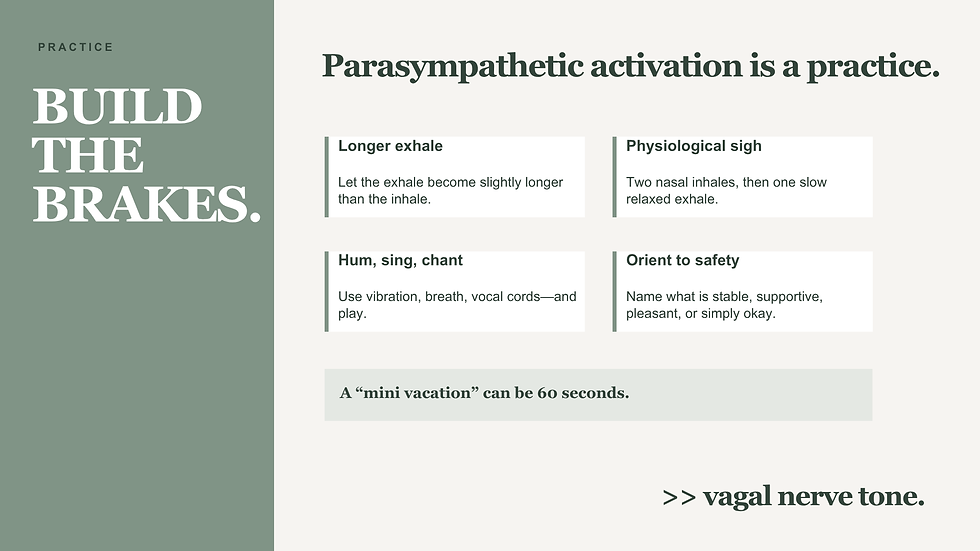
This is also why simple behaviors can matter more than they appear to. Slow breathing, chewing your food, singing, humming, meditation, movement, and even creating a calmer environment around meals can all provide sensory input associated with shifts toward a more regulated state.
These aren’t magic vagus nerve “hacks.” They are opportunities to repeatedly practice regulation.
Start With Sleeping, Pooping, and Blood Sugar Control
At The Facility, we joke that regardless of what someone comes in with, we tend to come back to three things:
Sleeping
Pooping
Blood sugar control
Not because those are the only things that matter, but because they tell us an enormous amount about the underlying regulatory environment.
When I say sleep, I’m also asking about your morning light exposure, movement, circadian rhythm, caffeine intake, stress, connection, and recovery. When I say pooping, I’m thinking about digestion, motility, food tolerance, the intestinal environment, and nervous system function. When I say blood sugar, I’m thinking about food, muscle, stress hormones, sleep, movement, and metabolic resilience.
The body doesn’t operate in separate departments. Neither should healthcare. #functionalmedforthewin
Schedule Wins
There is one piece of advice from this talk that requires virtually no understanding of neuroscience:
Schedule wins, because the losses schedule themselves.
There will always be another deadline, difficult conversation, sick family member, unexpected bill, bad night of sleep, delayed flight, or season of life that asks more from you than you expected. The goal is not to remove all of those things. The goal is to deliberately put experiences on the other side of the ledger.
A “win” might be yoga. It could also be:
A walk outside
Dinner with people you love
Strength training
Singing in your car
Sitting quietly for five minutes
Calling a friend
Cooking
Taking a few slow breaths before you eat
Your nervous system doesn’t care whether your regulation practice is impressive. It cares whether you practice regulation.
Yoga Is Bigger Than the Pose - Yoga Is Primary Care
If yoga were only useful because it made you flexible, I wouldn’t be nearly as interested in it. Its value is that it trains several things simultaneously: physical capacity, attention, breathing, awareness, stillness, the ability to tolerate discomfort without immediately reacting to it, and perhaps most importantly, the ability to return. That last one may be the most useful skill of all.
We train because life is going to happen. We take care of ourselves not because we can guarantee we’ll never get sick, experience loss, encounter trauma, or go through something difficult. We do it because resilience matters when those things arrive.
If you enter a difficult season with physical capacity, supportive relationships, metabolic health, emotional resilience, and some practiced ability to regulate your nervous system, you have more resources available to you. Yoga is one way of building those resources. And the benefits aren’t ultimately measured by what happens in pigeon pose. They show up afterward: in how you respond to your family, how you handle the stressful email, how you digest dinner, how quickly you recover from a difficult day, and whether you can recognize the body whispering before it has to yell.
That is why I believe yoga belongs in the conversation about primary care. Not instead of medicine. Long before we need it.
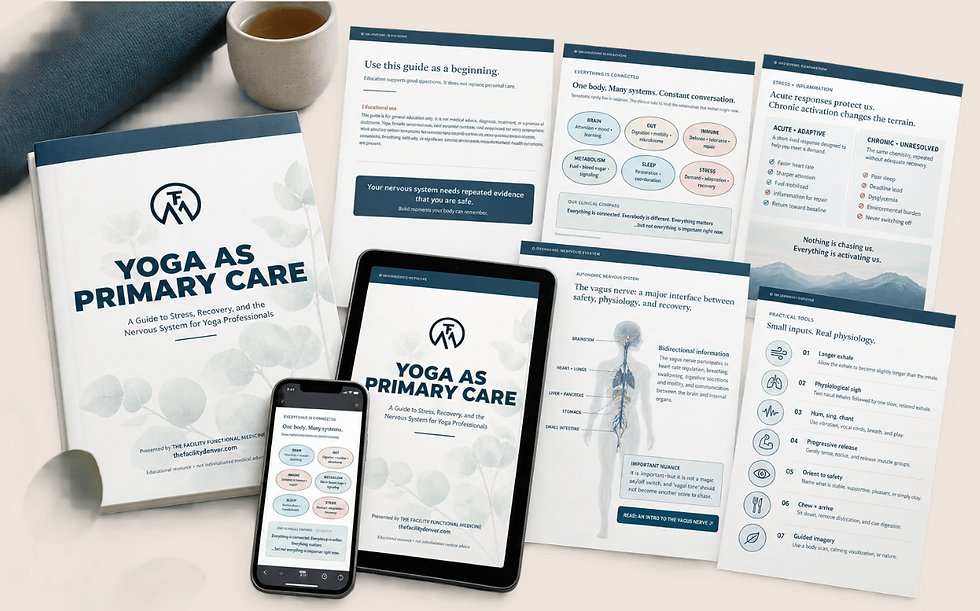
Want to dive deeper into the research on yoga and its physiological benefits? Need to go in-depth on the inflammation-chronic stress-immune loop ... we got you. Get our FREE RESOURCE GUIDE to accompany Dr. Mitchell Rasmussen's talk "Yoga is Primary Care" | Download Here
Key Takeaways
Yoga Is Primary Care
Yoga is more than movement or flexibility. A regular yoga practice can influence stress physiology, nervous system regulation, metabolic health, cardiovascular function, and resilience, making it a meaningful part of preventive health.
Stress Isn’t the Problem. Staying Stressed Is.
The body is designed to respond to stress. The problem develops when chronic stress keeps the nervous system activated without adequate recovery. The goal isn’t to eliminate stress, but to improve our ability to return to a regulated state.
Inflammation Isn’t Always Bad
Acute inflammation is essential for healing and immune defense. Chronic, unresolved inflammation is different and is associated with many chronic diseases. Healthy physiology requires both an appropriate inflammatory response and the ability to resolve it.
Your Nervous System Affects More Than Your Mood
Nervous system regulation influences digestion, sleep, blood sugar, immune function, energy, and recovery. This is one reason stress management needs to be considered part of physical health, not simply mental health.
The Vagus Nerve Connects the Brain and Body
The vagus nerve is an important part of the gut-brain connection and parasympathetic nervous system. Breathing, movement, chewing, humming, singing, and other practices can provide sensory input that supports the body’s ability to shift toward a more regulated state.
Start With the Foundations
At The Facility, we often start with sleeping, pooping, and blood sugar control. These basic functions provide valuable information about digestion, metabolic health, circadian rhythm, stress physiology, and overall resilience.
Schedule Wins
You cannot eliminate every stressor from your life. Yoga, exercise, time outside, meaningful relationships, shared meals, and other restorative practices intentionally create opportunities for the nervous system to experience recovery.
The Real Benefits of Yoga Happen Off the Mat
Yoga can build physical capacity, attention, breathing awareness, stress resilience, and the ability to return to regulation. The goal isn’t a better pose. It’s having more capacity to handle what happens after you leave the studio.
Work with us at The Facility Functional Medicine:

If you’re curious about functional medicine and how it could work for you, we’d love to help. Book an initial consultation with our Denver-based clinic (we see patients locally and via telehealth) and take the first step toward a health journey that doesn’t stop with you.
Meet The Functional Medicine Team at The Facility:

Mitchell Rasmussen, DC, CFMP: Mitchell is a certified functional medicine practitioner with a doctorate in chiropractic at The Facility Functional Medicine Clinic in Denver, Colorado.
With lots of letters behind his name, he entered chiropractic with a clear goal: to practice Functional Medicine. His biggest passion is the immune system. He has focused his post-doctoral education on immunology and clinical applications for chronic diseases like Lyme, tick-borne pathogens, viral burden, and mold exposure.

About Kate Daugherty, MS, CNS: Kate is a certified nutrition specialist and functional nutritionist at The Facility Functional Medicine Clinic in Denver, Colorado.
She began her career journey in neuroscience, which seamlessly transitioned into human nutrition. Utilizing food as medicine to treat the mind-body connection is truly remarkable. Kate believes that our eating habits nourish our soul as profoundly as they do our body.


Comments